
Quick answer
Most TRT apps are built around logging, reminders, and streaks: the easy part. But if your protocol isn't working, tracking it more carefully won't fix it. Two things actually decide whether a protocol works: whether it's well designed (the right compound at the right frequency) and whether your bloodwork and lifestyle back that up. TRT Plus is built in that order. Get the protocol right first, with frequency optimization, pharmacokinetic modeling, and bloodwork interpretation built for optimized and enhanced levels. Then track it, if you still need to.
Start with whether the protocol works
What's the point of tracking a protocol that isn't working?
The app market has settled on one template: log your dose, get a reminder, watch the streak build, become a Protocol Pro, you're awesome! None of them touch the two things that actually decide whether a protocol works: whether it's well designed, and whether your bloodwork and lifestyle reflect that.
TRT Plus is built the other way around.
The reminder problem doesn't need an app
If the honest reason your protocol isn't working is that you keep forgetting to dose, that's an adherence problem, and it has a free fix: Apple Health's medication reminder, or a calendar alert. Staying on schedule is the baseline expectation for an adult, not the product you're paying for.
TRT Plus does support daily dose logging. That's a given, just not where the value is. Once your protocol is right, logging it is the easy 20%. The effort went into the hard 80%: getting the protocol right in the first place, and making sense of bloodwork data that tells you whether it's working.
Frequency is where most protocols actually fail
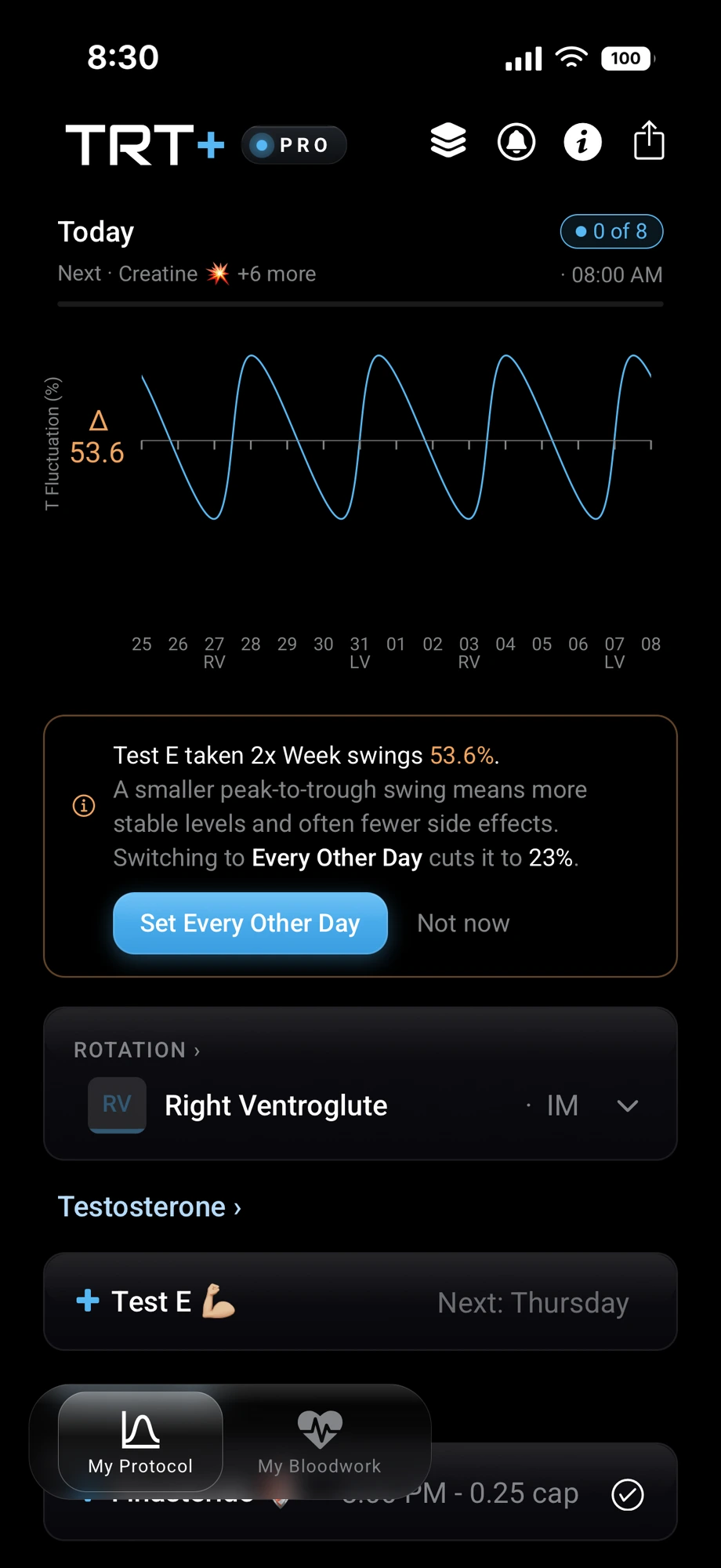
A huge number of clinic-issued protocols default to single or twice-weekly dosing because it's operationally simple for the clinic, not because it produces the most stable levels for the patient. That creates a real peak-to-trough swing: sharp for a few days after the dose, flat before the next one. TRT Plus puts a number on that swing: your Peak-to-Trough Fluctuation (PTF), calculated from your specific testosterone ester and dosing frequency. It's the single clearest measure of how much your levels actually move across the week, and no other app surfaces it as a hero metric. That swing is frequently what people describe as TRT "side effects, or not working," when the compound and the weekly total were never the problem. The frequency was.
TRT Plus reads your exact ester, dose, and frequency, so when your swing is larger than it needs to be, it calls out the most practical frequency to tighten it, tuned to your protocol.
When frequency is right but symptoms persist
Symptoms that persist after frequency is addressed usually have more than one driver. Bloodwork gives you objective signal on the protocol side, but lifestyle factors like training, stress, nutrition, and alcohol or partying are equally significant, and they move the same markers. The honest answer is that both need attention in parallel, and bloodwork is what helps you tell them apart.
This is where the overwhelming majority of the development effort in TRT Plus has gone, because interpreting labs for someone actively optimizing is genuinely hard, and it's the part the rest of the market mostly skips.
Standard reference ranges were built for the general population, not for someone running testosterone at optimized or enhanced levels. Applied routinely, they produce misleading reads: markers flagged as fine that aren't optimal, and markers flagged as concerning that are simply expected on protocol. TRT Plus uses enhanced reference ranges built from real-world TRT and enhanced protocol cases, paired with a weighted Biomarker Score and hormone ratio analysis, so you're reading the relationships between markers, not isolated numbers.
For enhanced protocols, the depth matters more. Optimizing IGF-1 alongside testosterone, managing the testosterone-to-estradiol ratio for muscle growth, interpreting androgenicity in the context of a stack. These conversations have mostly lived in performance-clinic circles and niche coaching communities until now.
Get the protocol right. Then track it.
Logging and reminders are the easy part, and the market has fully saturated that layer. Protocol optimization, and bloodwork interpretation built for people running at TRT or enhanced levels. That's the part nobody has built.
Frequently asked questions
Does TRT Plus have dose logging and reminders?
Yes, for testosterone and all of your compounds. The value is in what comes before logging: designing a protocol that's actually worth tracking.
What does the Testimator do that a tracker doesn't?
A tracker records what already happened. The Testimator models what your levels would look like on a protocol you haven't run yet, anchored to your own bloodwork, so you can dial one in before committing to it.
Why not just use the reference ranges on my lab report?
Those ranges describe the general population, not someone optimizing on TRT. Applied routinely they mislead, flagging expected-on-protocol values as problems and optimal-but-not-average values as fine. TRT Plus scores against enhanced ranges built from real-world TRT and enhanced cases instead.
Does this replace my healthcare provider?
No. Protocol and dosing decisions should always be made with your healthcare provider. TRT Plus helps you interpret your protocol and bloodwork together, so the conversation starts from solid ground.
This article is for informational purposes only and does not constitute medical advice. Consult with your healthcare provider before making medical decisions.
Build a protocol worth tracking
TRT Plus is pharmacokinetic modeling, frequency optimization, and enhanced-level bloodwork analysis in one place: the hard 80%, not just the logging. Get TRT Plus.
Related reading
- How TRT Plus Analyzes Your Bloodwork: A Deterministic Engine, Then AI
- The Testimator: modeling your individual response
- The engine schematic and formulas