
Quick answer
TRT Plus splits bloodwork analysis into two jobs. First, a deterministic engine does the reasoning: it scores every marker against personalized, TRT-calibrated ranges, computes a weighted Biomarker Score, and runs your cardiovascular and metabolic markers through a cascade that sets your individual hematocrit threshold and testosterone ceiling. Then AI takes that finished, structured result and turns it into your 8-section Bloodwork Report in plain English. The math is deterministic and repeatable. The AI writes it up. Same labs in, same analysis out.
Two jobs, kept separate
Analyzing your bloodwork is really two jobs, not one.
The first is reasoning: what does this number mean, against the right range, in the context of every other marker, and where does it sit relative to a ceiling you're managing to? That work needs to be deterministic, testable, and bounded. The same inputs should always produce the same result. That's traditional engineering.
The second is interpretation: taking that result and explaining it in language you can actually act on. That work needs to be fluent, adaptive, and readable. That's what modern AI is genuinely great at.
TRT Plus keeps these separate. The engine decides. The AI explains.
What the engine does before the AI sees anything
This is the part that matters most. The engine processes your labs first, deterministically and the same way every time, and only its structured output is handed off. Every score, range, and ratio is produced by a programmatically engineered model, not approximated by a language model. And the models and ranges themselves come from deep analysis of de-identified, real-world TRT clinic data. That's the foundation under every threshold, score, and ceiling the engine applies. That pre-processing is the product:
- Personalized reference ranges. Every marker is scored against TRT-calibrated ranges. In-range for the general population, much of which is prediabetic, overweight, and inflamed, is the wrong target for a man on TRT who trains and eats with intent. Your ranges should reflect the room at Dick's Sporting Goods, not the checkout line at Walmart.
- A weighted Biomarker Score. Markers are weighted by clinical importance and read as relationships and ratios (testosterone to estradiol, testosterone to SHBG), not isolated values. Marker and ratio scores are composited into one score you can track over time.
- The Cardio-Metabolic Cascade. Six cardiovascular and metabolic markers — systolic and diastolic blood pressure, ApoB, CRP, body fat, and HbA1c — feed into your hematocrit threshold, which in turn sets your personalized testosterone ceiling. Lean and metabolically healthy extends a higher ceiling; rising risk tightens it.
- The Growth Axis. Your IGF-1 range scales the same way, with your glycemic control: estradiol enables the conversion of growth hormone into IGF-1, and HbA1c gates how high it runs.
- Androgenic Load (A:E). Your androgen-to-estrogen picture accounts for DHT's outsized receptor potency and non-linear amplification, not a flat testosterone-to-estradiol number.
- Zakharov Free T. Free testosterone is solved with a model that holds up at TRT and supraphysiological levels, where the standard population formula drifts.
By the time the AI is involved, the judgment is already made. Every number has been scored, every range personalized, every ceiling set, deterministically and identically on every run.
The cascade in action: hematocrit
Hematocrit is the clearest example of why cascading matters, because a single number means very different things depending on what surrounds it.
Your hematocrit isn't read alone. It's gated by the cardio-metabolic cascade. If your blood pressure, ApoB, CRP, body fat, and HbA1c are all in range, the engine recognizes a lower-risk profile and applies your context-adjusted threshold. As each of those markers slips into amber and then red, the ceiling tightens progressively. Every downgrade in the cascade pulls your hematocrit threshold down another step. Your acceptable HCT isn't a fixed line. It's context-adjusted, and it moves with your cardiovascular picture.
Paste your bloodwork with a hematocrit of 54 into ChatGPT and it may tell you to donate blood immediately. Run the same result through TRT Plus, and the engine can see that your blood pressure is perfect, your atherogenic particles are in range, your inflammation is low, you're lean, and your glucose control is excellent. A hematocrit of 54 here doesn't cause alarm, it is read as tolerated and monitored in context. See the difference?
Then the AI: your 8-section report
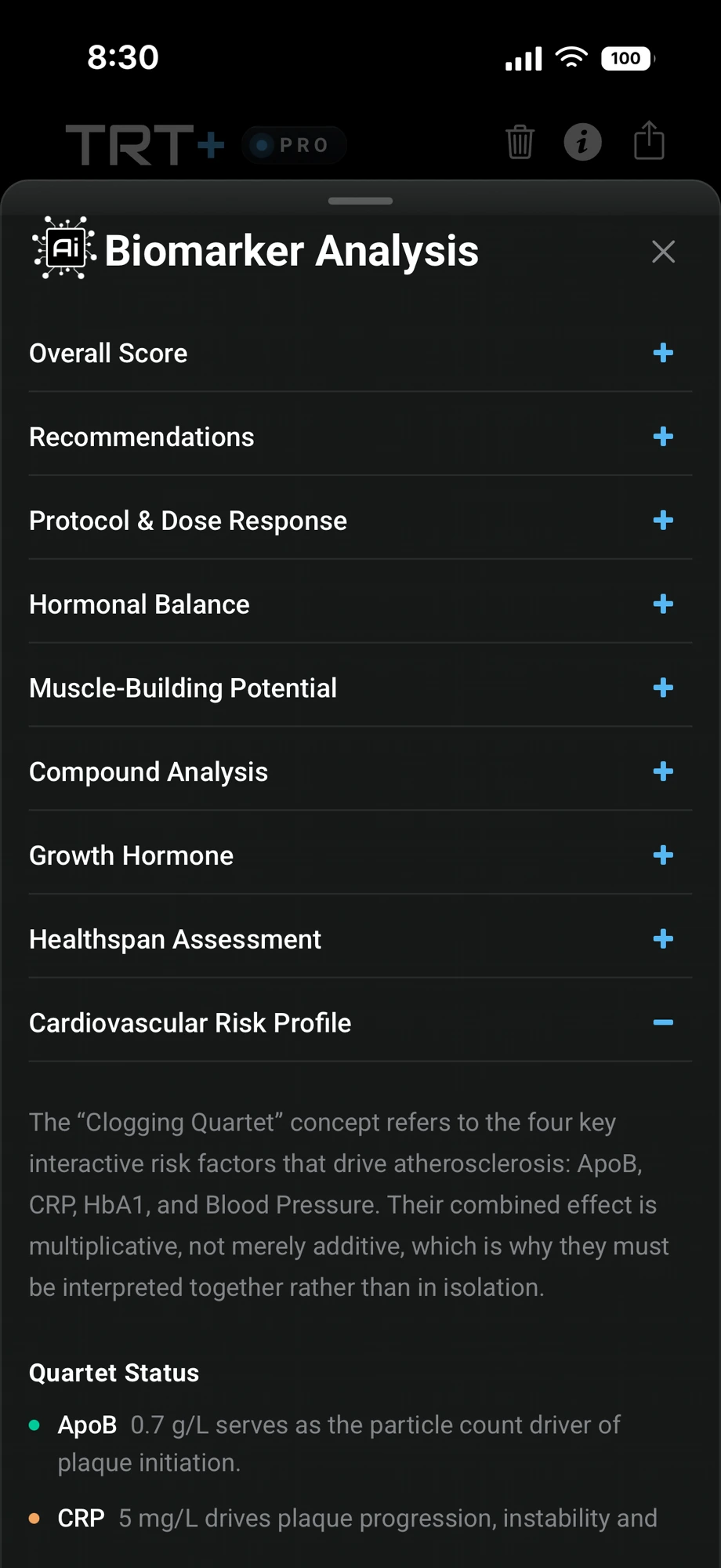
Now the AI goes to work on the engine's output, not your raw labs. It takes the scored markers, the personalized ranges, the ratios, and the ceilings the engine produced and writes your 8-section AI Bloodwork Report. It opens with your recommendations: the top 3–5 highest-priority actions, with each recommendation spelling out the lifestyle, supplement, and medicinal strategies to get it done. From there it moves into the deeper sections: your Anabolic Potential Rating, Hormonal Balance, Responder Type, a Cardiovascular Risk Profile, and a Healthspan Assessment.
The AI's job here is interpretation and language: narrating the engine's math in a way you can read and act on.
Why this produces consistent, personal results
Because the reasoning lives in the engine, the same labs always produce the same analysis. When a marker moves from one draw to the next, you know it's your blood changing, not the model's mood. And because your ranges and ceilings are set to you rather than a population average, the read is personal.
A deterministic foundation, an AI that speaks plain English.
Frequently asked questions
How does TRT Plus use AI?
Only for interpretation and language. AI takes the engine's finished, structured result and writes it up as your report. The scoring, the personalized ranges, and the clinical logic are the engine's job, and that part is deterministic.
How is this different from asking a chatbot to read my labs?
A general model gives you a fresh interpretation each time and leans on population reference ranges by default. TRT Plus fixes the ranges and the scoring in the engine first, so the analysis is personalized and repeatable, then uses AI to write it up. The difference isn't the AI; it's the engineered model in front of it.
Can I see how the engine works?
Yes. The schematic, the formulas, and the cited studies behind each model are laid out in the app and on the engine page. See the engine.
Does this replace my healthcare provider?
No. It gives you a consistent, contextualized read so the conversation with your healthcare provider starts from solid ground. It doesn't make the decision for you.
Do other TRT apps do this?
Hell no. Most apps advertising "AI bloodwork analysis" are wrapping the same general model you already have access to. You could dump your labs into Grok, type "analyze this," and get the same kind of answer, with the same inconsistency. The engine is the hard part, and it's the part that's missing. A deterministic framework built on real-world TRT clinic data is what actually turns your labs into a personalized, repeatable read.
Can I continue the discussion with my own AI?
Yes. A hand-off button packages your full report, your lab markers, and the framework and model context behind them, the cascade and growth axis included, and shares it to your installed Claude, ChatGPT, or Grok so you can keep exploring. This is the opposite of dumping raw labs into a chatbot: you're handing the general model the engine's finished, structured analysis along with the framework it was built on, so the conversation stays anchored to a deterministic read rather than the model improvising from scratch.
This article is for informational purposes only and does not constitute medical advice. Consult with your healthcare provider before making medical decisions.
See the engine for yourself
Every score, range, and ceiling in TRT Plus comes from a deterministic model. You can read the actual schematic and formulas. See the engine · Get TRT Plus.
Related reading
- The engine schematic and formulas
- Your 8-section AI Bloodwork Report
- The Testimator: modeling your individual response
- The Growth Axis: Why Your IGF-1 Range Scales With Your Health