
Quick answer
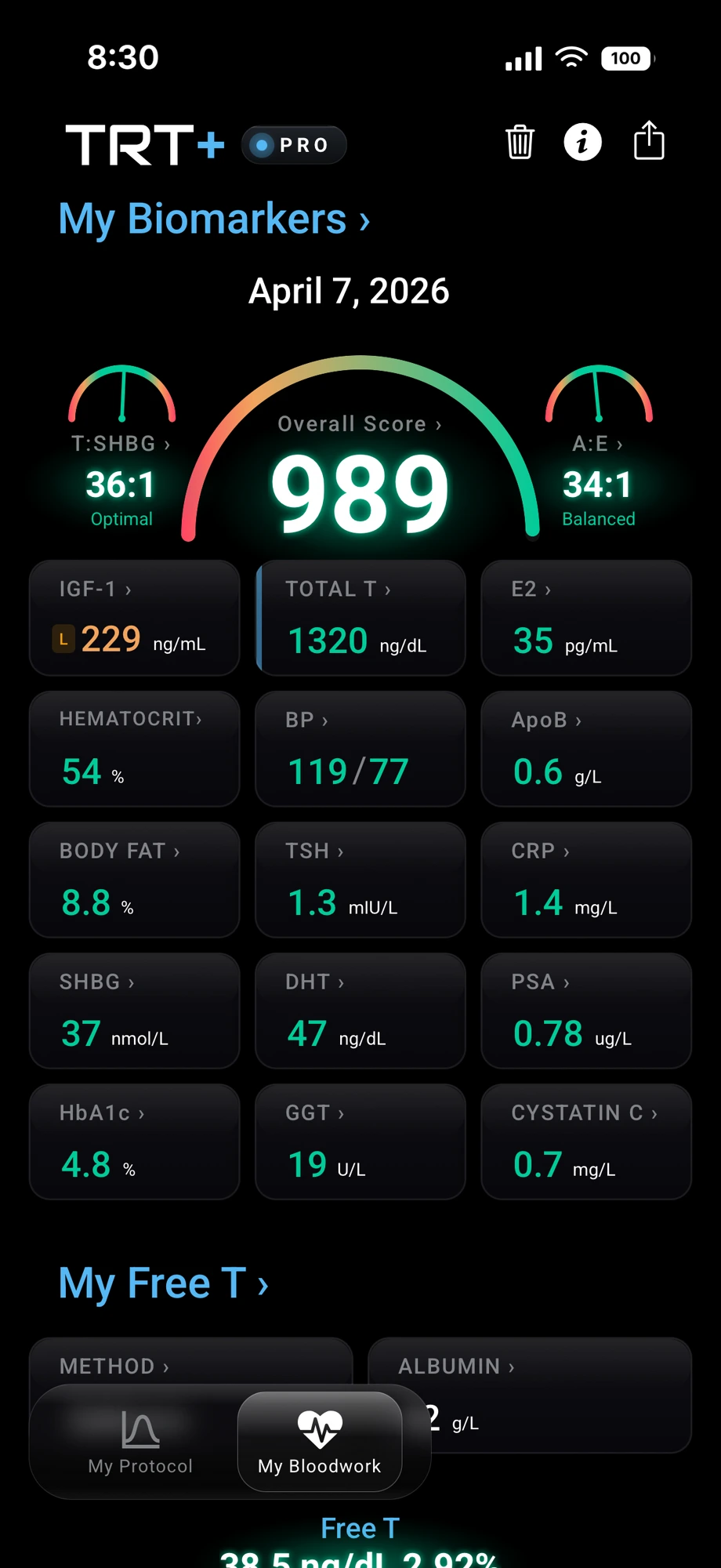
The Overall Score is the single number the TRT Plus engine produces from your bloodwork: a grade from 0 to 1000, measured against optimized TRT targets instead of the general population's. The engine weighs fifteen markers, reads them together in context, ratios included, and distills them into one figure. A perfect panel scores 1000, and every marker outside its target range pulls the score down.
The panel isn't wrong. The benchmark is.
Standard lab reference ranges are built from the general population, and the general population is not well. Those ranges are the average of a group that is, in large part, overweight, insulin-resistant, and inflamed. Score yourself against that and "normal" only means "typical." It doesn't mean good, and it's not the bloodwork of a peak male.
For a man on testosterone, that benchmark is worse than unhelpful. Your total testosterone reads high against a population that isn't jacked. Your hematocrit may sit above the untreated average. On a standard panel you look abnormal, because the panel is comparing you to people who aren't doing what you're doing.
The engine throws that benchmark out. It grades each marker against an optimized, TRT-calibrated target, so the number reflects how well your protocol is actually working, not how far you've drifted from a sick average.
Four tiers, not one "normal"
The core move is this: every marker is scored against one of four tiers, not a single population range.
- Optimal. A health-maximizing target, where lower or well-controlled is unambiguously better.
- TRT Calibrated. The dialed-in operating range for someone on TRT. At or above standard lab ranges by design, and not a risk driver in itself.
- Enhanced. Supraphysiologic territory, reachable only with enhancement protocols. A performance choice with a tradeoff, not a health optimum.
- Tolerated. A value that carries some intrinsic risk, accepted and monitored in context because your surrounding markers are low-risk. Monitored, not risk-free.
How the number is built
Everyone starts at 1,000. Each of fifteen inputs is compared to its target band. A marker inside its band costs nothing. A marker outside its band subtracts points, scaled by two things: how far past the edge it sits, and how heavily that marker is weighted. The penalties are summed and subtracted from 1,000.
So a lightly weighted marker sitting just past its edge costs a few points. A heavily weighted marker sitting well outside its band costs a lot. Two markers slightly out can cost less than a single marker far out on a heavy weight.
It's deterministic: no randomness, no black box. The same bloodwork always produces the same score, every time you open it. Where you land:
- 1000: Perfect
- 800–999: Excellent
- 650–799: OK
- 500–649: Not Great
- 250–499: Needs Attention
- Below 250: Terrible
It reads markers in context, not in isolation
The score isn't fifteen separate grades bolted together. Several bands move based on your other markers, because a number that's fine in one context is a problem in another.
Your testosterone band extends when your cardiovascular markers are clean, and tightens when blood pressure, ApoB, body fat, or HbA1c climb. High testosterone is better tolerated in an otherwise pristine metabolic picture, so the target reflects that. That's the Cardio-Metabolic Cascade.
Your IGF-1 target scales with your glycemic control. Good long-term glucose control gives you room to run IGF-1 higher; as control slips, the target eases down. That's the Growth Axis.
Your hematocrit ceiling is context-adjusted to your broader cardiovascular risk rather than read off a fixed line.
These adjustments change the range in context. They don't erase the risk a marker carries on its own.
What's actually in the score
Fifteen markers, each mapped to a real health outcome, grouped by what they watch:
- Hormonal: Total Testosterone, Estradiol, DHT, SHBG, and IGF-1, covering androgen status, body composition, and the growth and prostate signals.
- Cardiometabolic: Blood Pressure, ApoB (or LDL), CRP, HbA1c, Hematocrit, and Body Fat, covering the atherosclerosis, inflammation, glucose, and clotting risks that matter most on TRT.
- Systemic: TSH, PSA, GGT, and Cystatin C (or eGFR), covering thyroid, prostate, liver, and kidney.
Every one is tied to a peer-reviewed outcome, from atherogenic particle count to all-cause mortality. The point isn't more numbers. It's the right fifteen, weighted the way they actually matter for a man on TRT.
The method behind it
Distilling many markers into one index isn't new. It's an established approach in preventive-health and aging research, the lineage behind biological-age models (Klemera & Doubal, 2006; Liu et al., 2018) and the American Heart Association's Life's Essential 8 (Lloyd-Jones et al., 2022): one number built from many inputs.
The TRT Plus engine is our own implementation of that approach. Which markers are included, how they're weighted, and where the target bands sit were developed with TRT clinics, coaches, and pathology partners, and calibrated for men on testosterone therapy.
It has not been validated against health outcomes in a formal cohort study, and it isn't a diagnostic. It's a decision-support instrument, built to be read alongside your healthcare provider, not instead of one.
This article is for informational purposes only and does not constitute medical advice. Consult with your healthcare provider before making medical decisions.
Read the methodology
Every model, weighting, and target band behind the score is documented, with the schematic and formulas, on the engine page. See the engine · Get TRT Plus.
Related reading
- How TRT Plus Analyzes Your Bloodwork: A Deterministic Engine, Then AI
- The Growth Axis: Why Your IGF-1 Range Scales With Your Health