
Quick answer
Two things decide whether a supplement does anything for you. Whether it is the right one for the job, and whether you gave it long enough to work.
A supplement can be doing exactly what it should while you give up on it after a week, because you're just not feeling it. Often the cause is simply accumulation. It has not had time to build up to the level where it does anything.
TRT Plus charts this according to unique pharmacokinetic milestones, so you can see when a supplement has actually reached its potential.
Is it the right one for the job
Most supplements are worth taking for one of two reasons. Either you are correcting a deficiency, or you are targeting an intake that food alone will not get you to.
Vitamin D deficiency is common enough across the general population that supplementing is usually simpler than testing to confirm it.
You would need roughly a kilo of steak a day for a creatine dose, or oily fish several times a week for the omega-3 intake the study trials used.
Supplementing is the practical route for both scenarios.
Once you have picked something worth taking, the question becomes when can I judge it is working.
What is actually filling up
Creatine works by filling the creatine pool in your muscle. Some people notice something early, but the full effect is not there until that pool is full. Plasma creatine clears in about three hours, while the muscle pool takes about four weeks of daily dosing at 5 g to fill.
That is what old school loading protocols were for. Taking 25 to 30 g a day for a week fills the pool faster, but the tradeoff was also filling the toilet. Taking 5 g a day and waiting achieves the same, less the mad diarrhea.
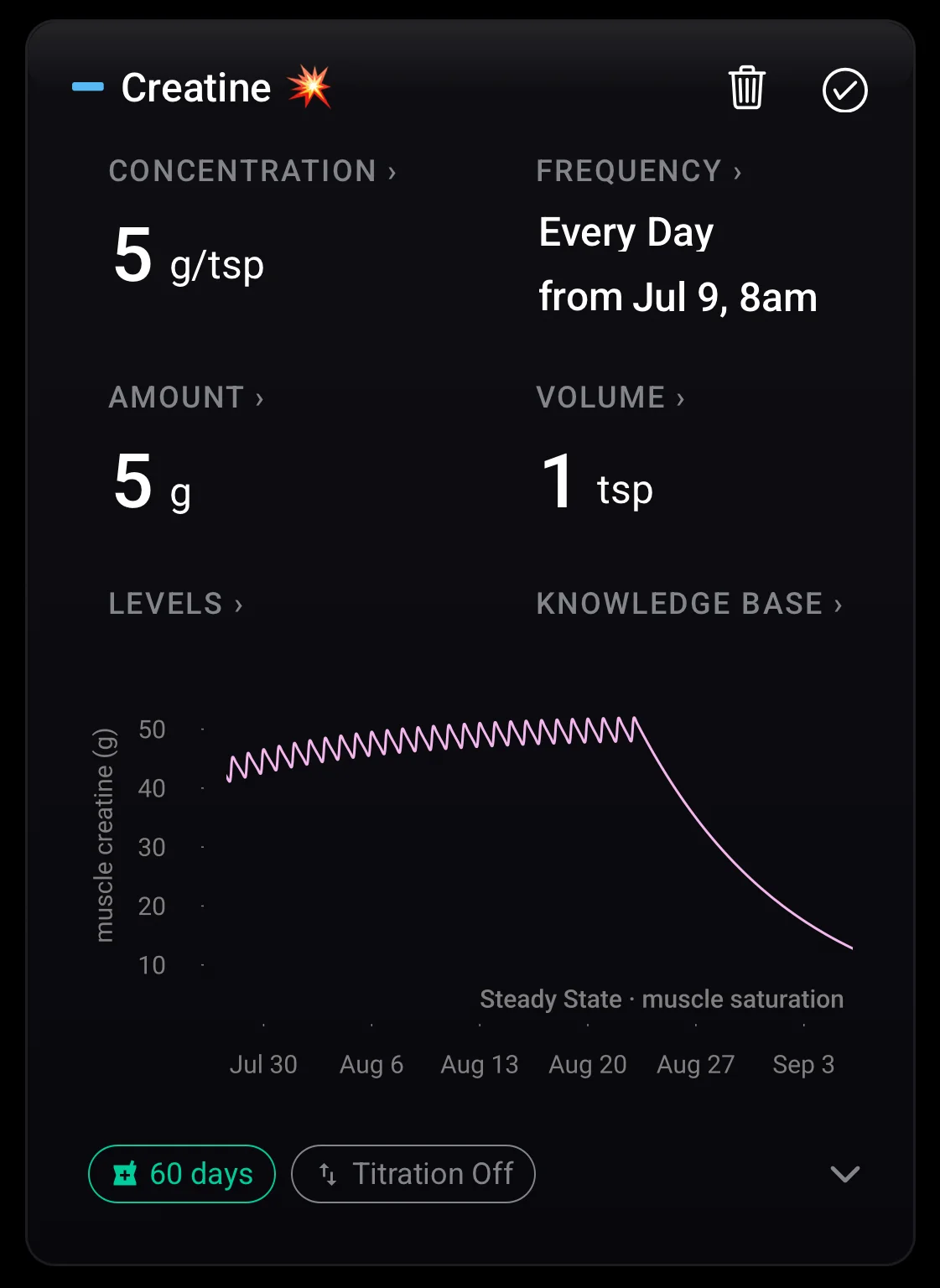
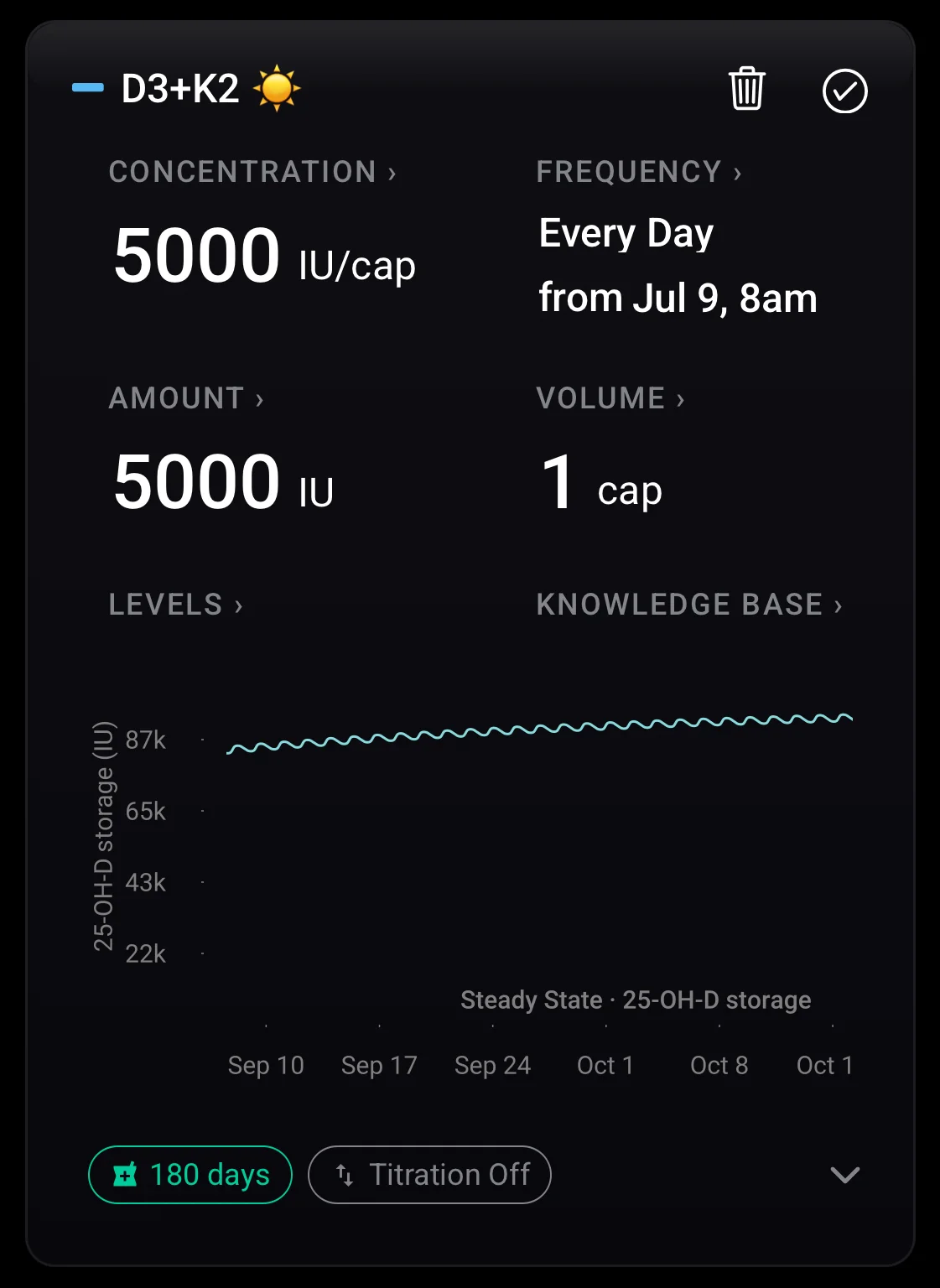
The same pattern runs through the other slow builders. Beta-alanine clears from plasma in about 25 minutes while the true measure, which is muscle carnosine, takes weeks. For fish oil, EPA and DHA clear in a day or two while membrane stores take months. Vitamin D3 clears from plasma in about a day while 25-OH-D, the storage form your lab reports, takes weeks to plateau.
This is why a dose change today will not move a vitamin D blood test result for weeks.
Supplement sample timeframes
| Supplement | What builds | Judge it at |
|---|---|---|
| Creatine | Muscle creatine | ~4 weeks |
| Beta-Alanine | Muscle carnosine | ~4 weeks |
| Magnesium Glycinate | Repletion | ~6 weeks for the sleep benefit |
| D3 + K2 | 25-OH-D storage | ~2 months |
| Fish Oil | Membrane stores | ~4 months |
Fish oil is the longest of these by far. At week six it's still on the way up, so give it the full four months.
Magnesium glycinate has a dual mechanism. There is a mild acute effect on sleep, attributed to the glycine, felt within hours. However, the fuller sleep benefit comes from repletion, the longer term restoration of your magnesium stores, and that takes about six weeks.
Beta-alanine, a useful case
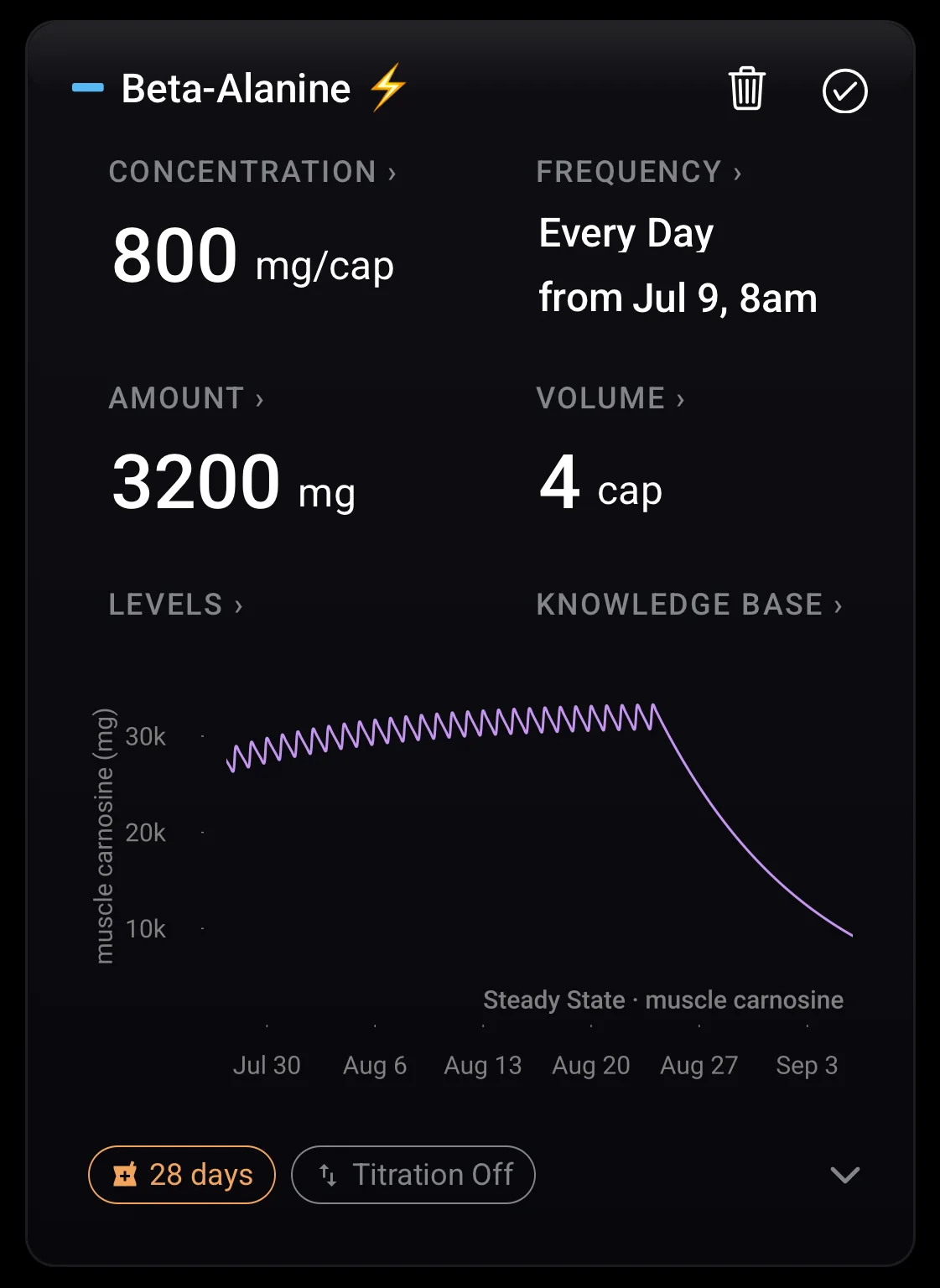
Beta-alanine (the tingler) is often sold in pre-workout blends, which suggests it works in the session you take it in. It does not. Beta raises carnosine, which has to accumulate, and that takes around four weeks of daily dosing.
The tingling reads like an acute effect, like it is working, but it is a nerve response to the dose itself and unrelated to muscle carnosine.
It also needs to be taken daily rather than on training days only. Dosing on training days alone never fills the pool, and the full effect depends on this.
NAC, where timing matters instead
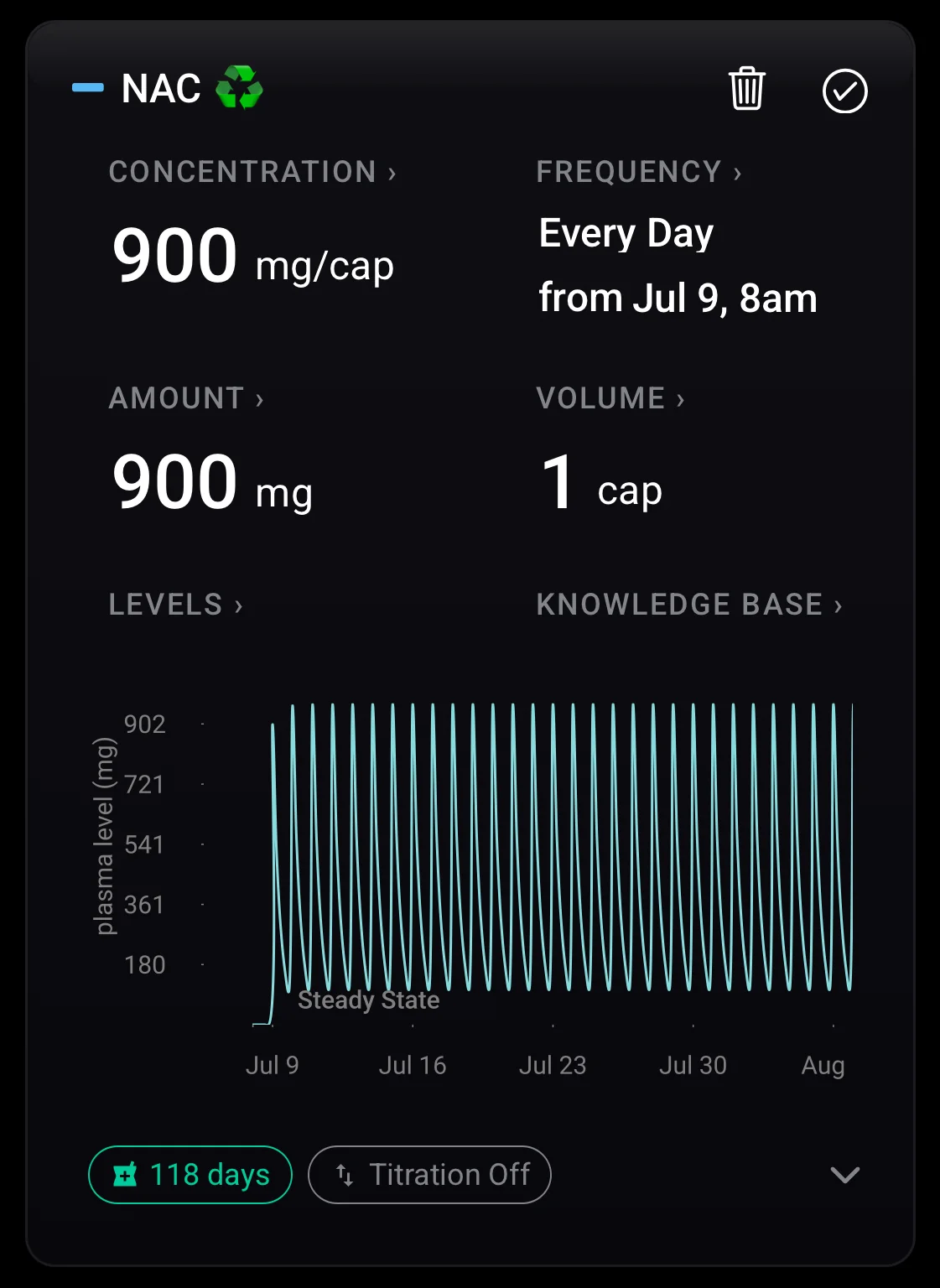
NAC is a substrate used to create glutathione, the body's master antioxidant. It is consumed as glutathione is made, so daily dosing is a top-up rather than an accumulation.
Its effects are acute, so it has to be timed accordingly. If you are taking it around a drinking session, it works best taken before the bender, since it needs to be present while the liver is detoxing as you go.
Seeing it on the chart
Your Levels chart plots the accumulation curve, each dose stacking on what has not yet cleared, peaks climbing until intake matches elimination. Two markers sit on that curve: steady state, where accumulation is done and the curve flattens, and 97% eliminated, for when something is substantially gone after your last dose. TRT Plus calculates both of these using published studies.
For supplements that accumulate in tissue, the curve is drawn against that pool rather than a blood level, and the chart marks the date each milestone lands on the timeline. Muscle saturation for creatine, muscle carnosine for beta-alanine, membrane stores for fish oil, 25-OH-D storage for vitamin D.
Taking the right stack for the job
Three curated stacks ship in the app, each added to a protocol in one tap at doses pulled from published research in the context of hormone optimization.
- S-Tier Supps. The non-negotiables for TRT. Four supplements, the first being D3 + K2.
- Liver Support. Detox and hormone clearance. Two supplements, the first being NAC.
- Metabolic Support. Glucose control and lipid balance. Two supplements, the first being fish oil.
Pick the right supps for the job, preconfigured in the app, then give them the time each needs according to the TRT Plus Levels chart.
This article is for informational purposes only and does not constitute medical advice. Consult with your healthcare provider before making medical decisions.
See it in the app
TRT Plus plots every supplement against the tissue pool that carries its effect, so you know exactly when each one is fair to judge. See the engine · Get TRT Plus.
Related reading
- Understanding Your Testosterone Dose Response
- How TRT Plus Analyzes Your Bloodwork: A Deterministic Engine, Then AI